|
Treat your own back Sleeping Postural Advice: The human body does not like its moveable (parts) joints to be kept at end range for long periods of time. Examples would be how sore the neck becomes after painting a ceiling. To do this requires keeping your neck in full extension for too long. The chances of people, who habitually sleep face down, getting neck problems including headaches, are very high. This is because the head is kept fully rotated to allow them to breath. Professional gardeners who spend day after day fully bent over, dealing with plants, can end up with sore degenerative back joints. Sitting daily at a desk with the neck in full flexion can result in degenerative lower neck joints. When older and entertaining guests, do not sit beside them too long with your head turned towards them. Sit opposite and you will not be troubled. I could go on and on…. Chemical pain is felt when there is some inflammation irritating nerves and causing pain. Examples would be arthritis or appendicitis. Some chemical pains can be treated with drugs, acupuncture, forms of heat or ice etc.
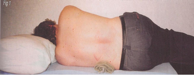
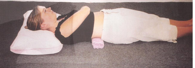
Fig1 – "Try sleep with a small soft pad under your waist."
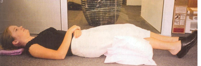
When pain in bed is of mechanical origin there are several things you can try to see if they resolve the problem. The following suggestions must be beneficial. If they increase your pain or discomfort then do not use them.
Sitting
Postural advice
Sitting is a big problem for those with spinal disorders. We are all encouraged to sit up straight and maintain the curve in the lower back (lumbar spine). When we do this our head and neck can be straight and not jutting forward. Lumbar supports are built into many chairs, car and plane seats etc. Many types of portable lumbar supports are on the market.
The best advice that anyone could give of course, is never sit for too long. If your job involves sitting, get up frequently and stretch out. When watching TV, every time the advertisements come on, stand up and walk around the room.
Fig 1 "Inspect your car seat"
The simplest way to get a better sitting posture is to fold a bed pillow in Now sit on the chair ensuring that the sitting bones are comfortably settled on the folded pillow. Immediately, the hips are now higher than the knees and the posture is improved. You should not feel that you are rolling forward on the pillow. See Fig 3.
Fig 2 "Place folded bed pillow on chair's seat"
A lumbar roll, if also needed, will now be more effective. Place a pillow thus folded on a dining chair at night and sit on this when watching TV. When seated properly the neck posture is also taken care of. If you sit before a computer, take a pillow to work and sit on it as described. The taller you are the greater the problem becomes when the height of the chair cannot be altered. For tall individuals, even with a folded pillow, the knees will be higher than the hips. A folded pillow may be too wide for an easy chair with the sides built in. Choose another chair.
When sitting, a folded pillow should be tried if you have a sore tail-bone (coccyx). It is often called coccydynia. This condition can persist for several weeks and sitting is always a problem. Most of my patients have found the use of a folded pillow on the chair as described above very satisfactory.
Fig 3 "Not feel you are rolling forward"
Another way of sitting with knees below the hips is to sit astride the chair with feet tucked back. See Fig 4.
Not an elegant idea for the fashion conscious woman wearing a mini skirt. There are of course chairs of the kneeler type. These are great for the back in that knees are below hips but can prove to be uncomfortable on the knees. The other point is that it is always nice to have something to lean back against and this is not the case with the knee chair.
Fig 4 "Tuck feet back"
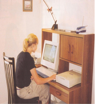
That computer screen really 'is a pain'. It draws our heads forward like a magnet and the end result, with regular computer usage, is upper back and neck pain and even headaches. See Fig 5. To stop this, I ask patients when sitting before a computer or TV screen to do the following ….. Firstly, sit on a pillow as described and minimally tuck in or lower the chin. Now be aware of the distance from the chin to the front of the neck and ensure that this distance does not change when staring at the screen. The head will not now be poking forward. Ensure of course, that the centre of the screen is just below eye level.
Fig 5 "Regular computer usage"
On rare occasions you will meet patients who are pain free when 'sitting badly', so be it. If the advice given does not make an immediate change for the better, ignore it.
Most people working over a desk bend their lumbar spines, which can lead to problems. See Fig 6. I give further advice to the patient who is using a flat desk's surface for reading, studying or writing.
In addition to using a folded pillow always flex over the desk by bending at the hips. For a change instead of sitting on the folded pillow when over a desk, come forward on the chair and flex your knees so that the feet are under the chair. See Fig 7. This keeps the back and neck straight.
Fig 6 ""Working over a desk"
If your lower back does not have its natural curve backwards it is virtually impossible to keep your head in a sensible posture. Ideal for those who are desk bound is to have an upward sloping surface to work on. See Fig 8.
Fig 7 "Keeps back and neck straight"
Fig 8 ""Working at a desk"
|