|
Arie Michaeli achieved dramatic results with the treatment of a swollen painful knee. Introduction
History
Relevant Physical Examination - the knee was warm to touch. Range of knee was 10/90. There was a 6 cm discrepancy between the knees measured at mid patella level and a 3 cm atrophy of the quadriceps measured at mid-thigh level. EMG studies showed poor activation of the right quadriceps (5 microvolts compared with 150 microvolts on the left). Ultrasound demonstrated thickening of the synovial walls with a small clear effusion of the supra patellar bursa. The anti-nuclear antibodies (ANAs) were low positive.
Figure 1: Photograph of knees prior to treatment on 01/06/2011.
Note the huge swelling of her right knee in comparison to her left knee.
Treatment
Clinical uses:
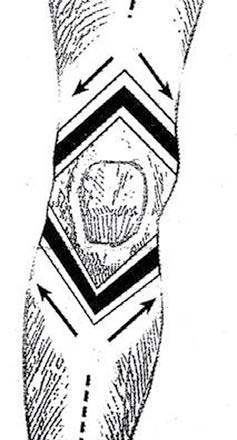
Figure 2: Diamond unloading rigid taping technique.
Please note that the tape does not compress the patellofemoral joint (PFJ); in fact a slight distraction effect of the PFJ is achieved.
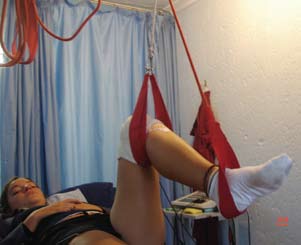
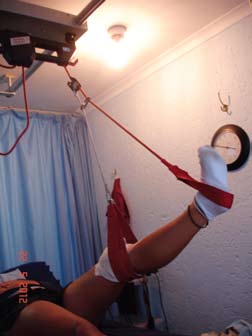
While wearing the DUT, a continuous active motion (CAM) device was applied three times per week, for 20 minutes each time. This was combined with Interferential therapy in motion (Figures 3A & B). At the end of the first session, her ROM measured 5/100 degrees. This particular CAM is a unique device developed for patients with severe knee pain and swelling or following surgical procedures. It allows patients to flex and extend pain-free in their available range of motion. It also assists with cartilage regeneration similar to the benefits described following the application of a continuous passive motion device.
Figure 3 A: CAM in full available flexion.
Elastic is attached to the knee providing minimal resistance to extension. Interferential is applied during the cycle motion of the knee.
Figure 3 B: CAM in full extension.
After 6 treatments over a period of 11 weeks, the swelling had disappeared and both knees appeared similar (Figure 4). Full ROM was attained. She only complained of pain at night and was taking Chinese medication for this. She used rigid tapes only when attending University.
Figure 4: Eleven weeks later – total of only 6 treatments (19/8/2011)
A one year follow-up
Discussion
The author maintains that the dramatic recovery without taking anti rheumatic medications is the result of effective physiotherapy along with DUT and CAM. This case report is not intended to imply that physiotherapy can cure Rheumatoid Arthritis. However, physiotherapy always forms a very important role of any rehabilitation of an inflamed joint. Invasive procedures are not always necessary to affect a cure.
Below is a letter that the patient wrote to me after just six treatments. I thought it would be of interest to read the patient's view about her healing process. Letter from Amy Chen to Arie Michaeli I have had a persistent knee problem for the past three and a half years. I experience constant pain in front of the knee. My knee swells dramatically every time I "overexert" it more than usual (e.g. walking uphill/climb stairs every day on my way to the lecture theatres at medical school).
I have undergone 3 invasive procedures to drain the fluid in my knee, and thought that this was the only way to reduce the swelling. Then I came to see you and you showed me that there are in fact non-invasive and less "destructive" ways to "drain" the fluid. This is the first time in these past years that the fluid in my knee has actually been consistently withdrawn by the natural healing processes in my body, enhanced by your treatment.
I think this means that my body is learning to self-heal owing to the confidence I gained from the results of your treatment. An added bonus is that my range of movement has increased dramatically; I am able to walk instead of limp. I will continue to do my exercises to secure my improvement.
In addition to being a great physiotherapist, Arie, thank you for being the caring person that you truly are.
Kind regards Amy Chen |