|
Arie Michaeli MSc achieved outstanding results with treatment Osteoarthritis of the Knee – Surgery was avoided. Introduction: Osteoarthritis of the knee is a major cause of pain and disability in older (and even younger) people. In people presenting with osteoarthritis of the knee, the joint loses both flexion and extension range of motion. This can result from damaged articular cartilage, pain avoidance, loss of extensibility of the capsule surrounding the joint, and loss of extensibility of the muscles acting over the joint. The problem with this disease is that there is no cure, and no easy way to treat it. Physiotherapy is aimed at reducing symptoms and improving function in general. Effective conservative management can prevent or delay the need for surgery such as a total knee replacement. Case report: Mr Z is a 73 year old man. He came to see me for a second opinion after his orthopaedic surgeon suggested that he undergo surgery.
His problem started after he had a fall in early April 2012. This resulted in his knee becoming very stiff, painful and swollen. It was so severe that he was even forced to use a walker and was obviously very uncomfortable and in tremendous pain.
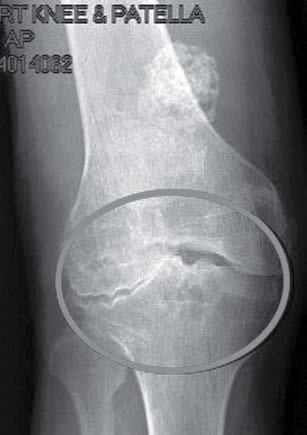
His extension and flexion were markedly limited (20/65). There was no mobility of the accessory movements of the patella. X-rays taken a few weeks after his fall showed that unfortunately his knee was grossly arthritic. In fact, it was one of the worst cases I had seen in my long career. (See Figure 1).
Figure 1: Mr Z's knee X-ray shows marked narrowing and degenerative changes in the joint space.
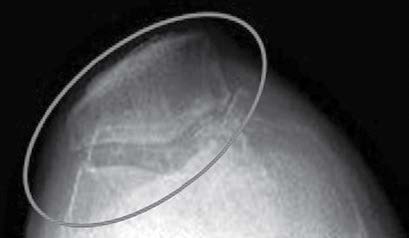
His patellofemoral (PF) joint also showed marked degenerative changes (See Figure 2).
Figure 2: His patellofemoral (PF) joint is markedly arthritic.
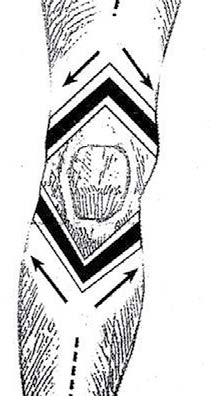
From these X-rays, and Mr Z's complaints, one can deduce that he had severe arthritis in his knee. Treatment & Results: I regarded Mr Z's knee as a personal challenge. I was determined to do everything I could to help him to avoid or at least delay surgery so I devised a unique treatment plan, tailored to his specific condition. We got to work and Mr Z played his part by following the treatment plan with enthusiasm. The treatment focused on reducing pain, swelling and improving the range of movement of the knee. This involved the use of four modalities:
The last three techniques assist in 'oiling' the joint. The combination of these 3 modalities have a powerful effect in reducing the symptoms of arthritic knees.
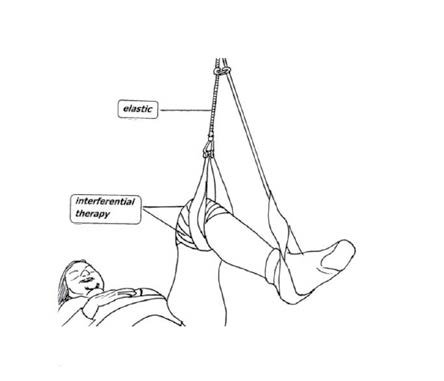
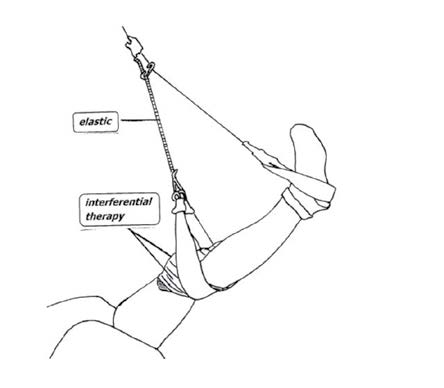
Figure 4 A: Healing in motion, knee in full flexion. The knee is taped and Interferential is given whilst exercising.
Figure 4 B: CAM - Healing in motion, knee in full extension. Taped with Interferential.
After only 6 sessions over a 3 week period, Mr Z could walk. He no longer had pain and he did not need a walker. His range of knee motion had improved to the level he had before the fall (10°/70°). Patellofemoral accessory movements were a few milimetres better. Needless to say, Mr Z was extremely happy that he did not need surgery. Follow-up six months later: Mr Z attends Aqua aerobic exercise classes regularly. His condition is now similar to that prior to the fall. Discussion and conclusion: It is now well established, particularly in instances of lower back pain, that there is no correlation between radiological findings and a patient's symptoms. A patient might have an X-ray showing gross radiological changes but experiences no pain whatsoever. On the other hand, patients might complain of severe pain but the X-rays are clear.
In this case, the patient's degenerative changes had probably existed for a long time. The purpose of the treatment was to reduce the symptoms and not to change the X-ray.
Of more concern than the radiological changes was the fact that his knee flexion and extension were markedly limited. However, he is still able to function remarkably well for a man of his age.
In conclusion, a challenging case of severe osteoarthritis of the knee has been assisted with an innovative physiotherapy approach and an exercise programme. An excellent outcome for the patient.
|